Why we exist, our story, how we work together, and the ethics we grow from. One page, four stops.
Soil
Why we exist.
Despite being one of the wealthiest countries in the world, inequities persist, especially for people whose knowledge, labour, and traditions are undervalued.
As newcomers engaging with these systems, we are rarely offered an honest account of this land and its Indigenous histories. We have witnessed gifted people welcomed for their labour yet pushed into menial jobs, while families struggle in isolation and vibrant living cultures are reduced to token gestures.
The story of multiculturalism, while noble in principle, can too easily conceal these enduring realities.
What research says
The opportunity we see is not only something we have experienced. Research points to a significant economic opportunity in better recognizing and mobilizing immigrant skills and entrepreneurship.
40%+
Immigrants are projected to account for more than 40% of Canadian entrepreneurs by 2034, up from 27% in 2014 and 34% in 2024. The share is already approaching half in Ontario and British Columbia.
BDC, 2024
Up to $50B
Underutilizing immigrants’ skills and education is estimated to cost the Canadian economy as much as $50 billion in lost GDP each year.
RBC, 2025
There is enormous capacity already here. The question is whether we create the conditions for it to flourish.
Pamoja exists as our response.
Our practice is rooted in complementarity and mutuality, not competition or exploitation. We use ethical dialogue, placemaking, entrepreneurship and professional development, social enterprise, and social finance, to create conditions where collective prosperity and mutual empowerment become the norm for everyone involved.
Guided by treaties and our own living traditions, we work to transform isolation into connection, and exploitation into collective empowerment.
Pamoja means “Together” in Kiswahili. It is more than a word. It is our guiding principle. The name was given to us by our older brother Waleed Abdulhamid after one of his original songs named Pamoja.
Rooted in Sudan, Waleed is a professor and musician and he represents a Canadian voice singing for peace and justice not only across Canada but all over the world, with songs in English, Arabic, Swahili, Kinyarwanda, and more.
Theme song Pamoja, by Waleed Abdulhamid — click to play the song
How we grew
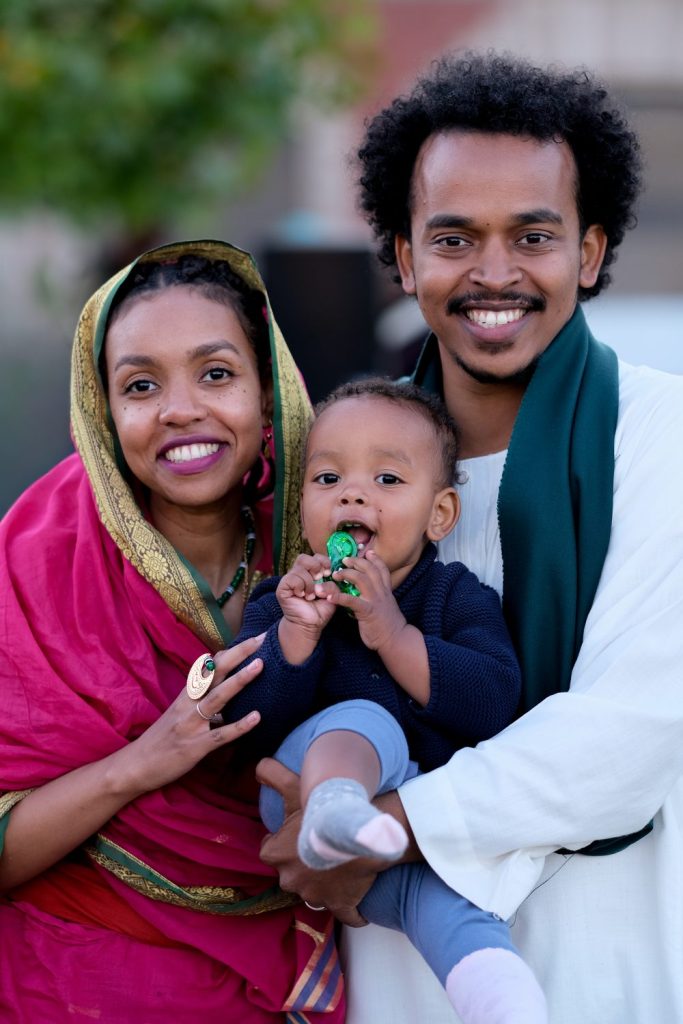
Pamoja Cultural Collective began in 2023 when newcomer husband and wife Abdo Habbani and Fatima Shulli decided to bring a Sudanese tradition of coming together around tea into their new home in Hamilton.
With generous support from the Community Permaculture Lab, and by sharing their space with us, Pamoja began as a simple biweekly tea gathering. For more than three years, that steady rhythm of coming together nurtured relationships across cultures, generations, and experiences. Over time, those relationships grew into what is now the Pamoja Cultural Collective.
But the idea of creating spaces where people can live with dignity began much earlier.
Abdo Habbani and Fatima Shulli, who put the kettle on in 2023.
2018 · Sudan
A vocational centre
Abdo and Fatima designed a vocational centre in Sudan to respond to the barriers craftspeople faced in turning their skills into sustainable livelihoods.
2017–2025 · Canada
The same problem, another form
They repeatedly witnessed newcomers pushed into menial work while their existing skills remained unseen, and a lack of awareness about the treaties and Indigenous histories of the land they had made home.
2023 · Hamilton
The tea gatherings
Pamoja emerged not from a strategic plan, but from people consistently coming together around tea at the Community Permaculture Lab.
Today
Pamoja Cultural Collective
Relationships across cultures, generations, and experiences, grown into a collective.
Next
A cultural hub
Community-funded nonprofit work for ethical dialogue and knowledge mobilization, with a cultural social enterprise for economic empowerment.
Imagine a mother working in an alienating factory while carrying generations of knowledge about cooking.
What if that knowledge could become part of a community kitchen? What if the skills people already carry could become sources of dignity, connection, and livelihood?
This is the kind of possibility Pamoja is working toward.
Roots
How we work together.
Within the collective
Consensus and consultation
Within our collective, decisions are made through consensus and consultation that reflect our shared values and responsibilities.
In our partnerships
Mutual consultation and dialogue
In our partnerships, we practice mutual consultation and dialogue.
Our way of working grows from Ta’aruf and Takaful, two traditions of our own.
Ta’aruf — An Arabic concept of mutual and respectful acquaintance between different peoples. For us, a practice of hospitality that builds trust, protects dignity, and lets difference remain without erasure.
Takaful — Mutual empowerment and collective stewardship. Prosperity that creates capacity for others rather than extracting from them.
Roots
Ethics and values.
Treaties as models for partnership
We work with treaties not only as intellectual teachings and principles we learn about, but as embodied practice of relationship, responsibility, difference and shared future.
We understand our gatherings as sacred space, and we take responsibility for the land and its covenants, including the Two Row and Dish With One Spoon Wampum Covenants.
From the Nile River to the Grand River, we weave threads of belonging into an ancient tapestry of mutuality. Our own rituals of community have taught us to value relationship, reciprocity, and responsibility.
We do not claim these covenants as our own. We honour them as Indigenous teachings and learn from them as models of ethical partnership, while grounding ourselves in our own traditions of Ta’aruf and Takaful.
Root 1
Epistemic sovereignty
Guided by Ta’aruf and our understanding of the Two Row Covenant
Walk side-by-side in mutual respect.
Epistemic sovereignty — our ways of knowing are ours: carried, practised, and taught on our own terms.
We honour stories, knowledge, and ways of being without assimilation or control. This resonates with our ethic of Ta’aruf, an Arabic concept of mutual and respectful acquaintance between different peoples.
For us, Ta’aruf is a practice of hospitality that builds ethical and dialogical relationships, develops trust, protects dignity, and allows difference to remain without erasure.
Root 2
Economic solidarity
Guided by Takaful and our understanding of the Dish With One Spoon Covenant
Take only what you need.
Leave some for others.
Keep the dish clean.
Takaful — mutual empowerment and collective stewardship.
This aligns with our ethic of Takaful, mutual empowerment and collective stewardship.
We believe prosperity is strongest when it creates capacity for others rather than extracting from them.